Project 1812: Echoes of War
Enjoy this sneak peek of the next sci-fi epic!
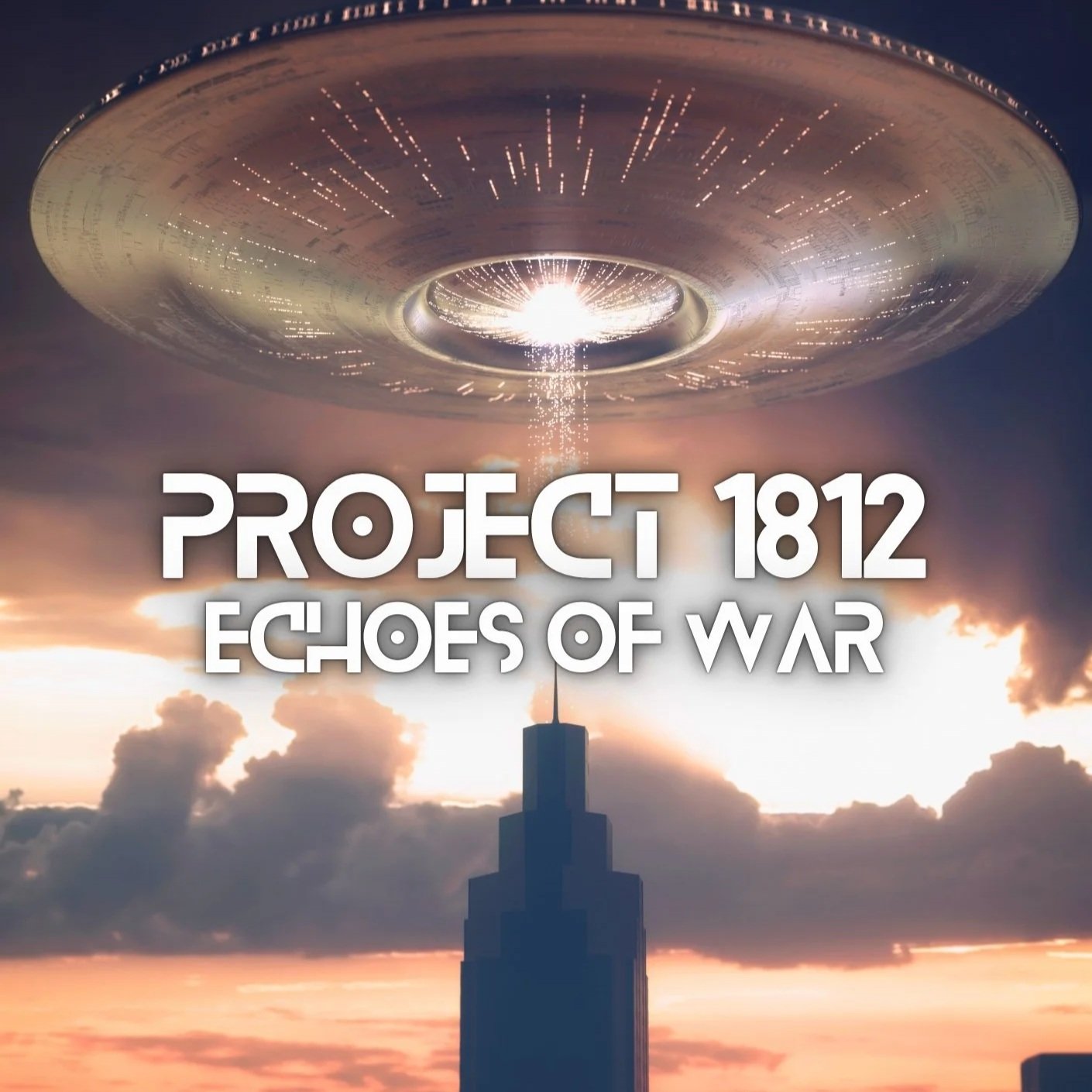
PROLOGUE: THE ARCHITECTS' BARGAIN
THE PRESIDENT'S HOUSE, FEBRUARY 1811
The candles had burned low by the time President James Madison set down his quill, rubbing tired eyes with ink-stained fingers. The reports spread across his desk painted a grim picture: British interference with American shipping had grown bolder by the month, and the ports along the coast simmered with tension between the United States and Great Britain. Madison knew something was brewing, and as president, he felt a duty to protect his people and this still-fragile young republic.
The British Orders in Council strangled American trade like a noose, seizing cargo and turning away vessels bound for the Continent. The French Continental System did the same from the other direction. Worse still, British warships routinely stopped American merchantmen at sea, impressing sailors into His Majesty's Navy on the flimsy pretense that they were deserters or British subjects. Along the frontier, rumors persisted of British agents in Canada arming Native confederacies against American settlements in the Northwest Territory. Caught between these warring empires, the young American republic suffocated.
Madison knew what the War Hawks in Congress demanded. The Speaker of the House, Henry Clay's voice still echoed in his memory: "We must fight for our sovereignty, Mr. President, or we have no sovereignty at all." But Madison had seen war. He knew its cost. He knew that America—barely thirty years old, its military weak, its treasury depleted—could not afford another conflict with the world's greatest naval power.
A soft knock interrupted his thoughts.
"Mr. President?" His private secretary, Edward Coles, stood in the doorway, his face pale in the candlelight. "There are... visitors. They claim to have urgent intelligence regarding British military movements."
"At this hour?" Madison glanced at the mantel clock. Nearly midnight. "Who are they?"
"They wouldn't say, sir. But they seem very adamant." Coles hesitated. "I think you should see them, sir." Madison looked at Coles with worry.
Coles continued, "They aren't human; I don't know what they are. The government has spoken of beings beyond our world, and I believe this might be our first contact."
Madison paused, unsure what to say or think. This could change history forever, yet he did not wish to bring panic to his country—or to his world.
Madison's instinct was to refuse whatever they wanted. But intelligent beings? How could Madison benefit from this? This could change everything. "Very well. Show them in, and make certain the guards remain close at all times!"
Minutes passed, and Madison kept wondering how they had arrived, what they looked like, and what they wanted. Questions outnumbered answers. Then—a knock. Another knock. Madison straightened his coat and took a breath.
"I am ready. You may enter."
The three figures who entered moved with an unnatural stillness that made Madison's skin prickle. They were tall, nearly seven feet, with pale, opalescent skin that seemed to shimmer in the candlelight. Geometric patterns flowed across their faces like living tattoos, shifting and reforming with each breath. Their clothing was perfectly tailored in a style Madison didn't recognize, neither European nor American, made from fabric that seemed to absorb light rather than reflect it. Their heads were covered, but their faces were visible in the candlelight.
"Mr. President." The lead figure's voice was measured, formal, utterly calm. "We are representatives of an advanced civilization. We have observed your world's development with scientific interest for several decades."
Madison felt his hand move instinctively toward the pistol in his desk drawer, though his personal guards stood just beyond the door. He felt nervous, yet strangely exhilarated at the same time. "What is it your species wants with our people?"
The figure raised one hand, and the air between them shimmered. A three-dimensional image appeared, floating above the desk: a vessel suspended beside what looked like the Earth itself. Madison watched, transfixed, by technology decades—perhaps centuries—beyond anything his world possessed. "This is our vessel, currently in the space above your world," the Architect said. "Such technology could be yours, Mr. President, while the rest of the world struggles simply to catch up to your nation."
Madison was immediately intrigued by the offer, but he wondered one thing. What did they want in return?
"This is a sight to see. I can scarcely fathom what I am looking upon, but I confess I like it," Madison said, unable to hide his excitement. "What does your species want?"
The Architects looked at one another before replying in unison: "We are here to help this nation, the people who reside within it, and its future." Madison found himself unsettled, as though he were listening to the practiced cadence of a cult. Were they real? Why did this offer seem so generous? Why America?
"Why us, though? Why not the whole world?" Madison asked quickly.
"We believe the people of this nation possess a rare potential, and we wish to help preserve it." The Architects' expressions remained neutral, and the room seemed to grow heavier for it.
"And if we decline?" Madison asked, bracing himself for the answer.
The Architects shifted, their patterns rippling like disturbed water, and when they spoke again, their words settled over Madison like a shadow. "Decline, and history will remember what befalls this nation regardless of our involvement. We offer only to change the ending you already fear."
Madison felt a flicker of fear beneath his confusion. "Wait—if we are truly the best, then why does your species want anything from us at all? Why not simply leave us be? This is our planet."
"We observe. We study. We understand." The Architect's patterns shifted, forming what might have been an expression of irritation. "And we have come to offer assistance, Mr. President. War with Britain is statistically inevitable. Our projections suggest conflict will begin within eighteen months. Without intervention, the outcome will be... costly for your nation."
Madison felt a rising suspicion, yet he did not wish to fail as president. This was madness, and yet the evidence floated before his very eyes. "What manner of intervention?"
The Architect gestured, and the image above the vessel shifted. Madison saw American forces engaged in battle—burning cities, naval engagements, armies clashing along the Canadian frontier. He saw Washington itself in flames, British troops marching through the capital. He saw casualty lists that made his stomach turn.
"This is the probable outcome without our protection," the Architect said. "Significant American losses. British occupation of major cities. Economic devastation. The possibility of your republic's dissolution."
The image shifted again. Now Madison saw different battles—American victories, British retreats, the nation emerging stronger and more unified. "And this is the outcome with our assistance. We can ensure American military success. We can prevent British domination. We can preserve your democratic experiment."
"At what price?" Madison's voice was steady despite the trembling in his hands. "What do you want in return?"
"Only to preserve the American experiment," the Architect replied. "To study the nature of your nation's resilience under pressure. We will intervene only where necessary. We wish to observe how your people respond to existential threat, how your institutions adapt, how your society evolves through conflict."
Madison studied the figures before him. Every rational instinct screamed that this was deception, manipulation, perhaps even demonic influence. Yet the evidence was undeniable. They knew things no foreign power could know. They possessed technology beyond anything he'd ever imagined.
"What would you require of me?"
"Create a classified initiative," the Architect said. "Call it 'Project 1812.' A secret commitment allowing us to work behind the scenes during the coming conflict. We will not interfere directly—your soldiers will fight, your leaders will command. But we will ensure that critical moments favor American success. Supply lines will function when needed. Intelligence will reach the right commanders. British advantages will be... neutralized at key junctures."
"You're asking me to trust beings I don't understand with my nation's fate."
"We are asking you to accept help that will save thousands of American lives." The Architect's patterns shifted, forming complex geometries. "The war is coming, Mr. President. With or without us. The only question is how many of your citizens will survive it."
Madison thought of the reports on his desk. The impressed sailors. The seized ships. The British arrogance that seemed to treat American sovereignty as a jest. He thought of the War Hawks demanding action, of the nation's honor at stake, of the impossible choice between war and submission.
"If I agree," he said slowly, "how would this arrangement function?"
The Architect produced a small device, no larger than a pocket watch, made of the same light-absorbing material as their clothing. "For communication, should you need it. Though we suspect you will not. We work best when unobserved."
Madison reached for the device, felt its strange warmth against his palm. He was making a bargain with forces he didn't understand, for stakes he couldn't fully comprehend. But what choice did he have? If war was truly inevitable—and he believed it was—then shouldn't he do everything possible to protect American lives?
"Very well," he said. "Project 1812. I will authorize it."
The Architects inclined their heads in unison. "Your nation will remember this decision, Mr. President. Though perhaps not in the way you expect."
They departed as silently as they'd arrived, leaving Madison alone with the strange device and a growing sense of unease he couldn't quite name.
THE PRESIDENT'S HOUSE, JUNE 1812
On June 18, 1812—the day President Madison signed Congress's declaration of war against Great Britain—he received Henry Clay in his private study at the President's House. Clay, the powerful Speaker of the House and one of the war's most forceful advocates, arrived expecting a discussion of military strategy. What he received instead would haunt him for the rest of his life.
"Mr. Speaker," Madison began, gesturing for Clay to take a seat. "I've asked you here because you, more than anyone, helped bring us to this moment. You deserve to know what I've done to ensure our success."
Clay settled into the chair, his characteristic confidence evident. "I'm pleased to hear you've secured advantages, Mr. President. Foreign alliances, I presume? The French, perhaps?"
"Not exactly," Madison said, his voice heavy. "I've made arrangements—arrangements I can barely comprehend myself—that will ensure American sovereignty and survival through the trials ahead."
Clay's expression shifted to one of concern. "What manner of arrangements?"
"I speak of Project 1812," Madison said, and the phrase felt heavy on his tongue. "A strategic initiative designed to preserve and shelter American citizens through this conflict. There are unseen protectors working to ensure that our democratic experiment endures, that our people survive, that our nation emerges from this war stronger and more unified."
"Mr. President," Clay said slowly, leaning forward, "what manner of protectors? What foreign power has pledged such support?"
Madison met his gaze steadily. "I cannot provide those details fully. I ask you to trust that I have acted in the nation's best interest, that I have secured advantages that will prove decisive in the months ahead."
Clay's face darkened. "James, you summoned me here in secret to tell me nothing? I've staked my political career on this war. I've convinced skeptical colleagues that we can prevail against the British Empire. Now you speak in riddles about 'unseen protectors' and 'arrangements' you cannot explain?"
"I understand your frustration. I share it, in many ways. But I have seen evidence—evidence I cannot share—that convinces me we will prevail. That American lives will be preserved. That our sovereignty will be maintained. I ask only that you trust in the arrangements I have made, and in the Providence that guides our nation's destiny."
The meeting lasted fifteen minutes, but Madison felt every second of it. He was lying to Clay—not about the existence of the arrangement, but about its nature, its purpose, its true cost. Yet what else could he do? Tell him about beings from another world? About technology that defied natural law? Clay would think him mad, or worse, would spread word that the President had lost his mind.
After Clay departed, clearly unsettled and dissatisfied, Secretary of State James Monroe entered. "James, what in God's name was that about? What arrangements? What protectors?"
"I've secured a secret alliance," Madison said, the half-truth bitter on his tongue. "Foreign powers who will work behind the scenes to ensure our success. That's all I can say."
Monroe studied him with concern. "You're certain this is wise?"
"I'm certain that war is inevitable," Madison replied. "And I'm certain that I've done everything in my power to protect American lives. Beyond that..." He trailed off, thinking of the strange device locked in his desk drawer, the beings with their shifting patterns and impossible knowledge. "Beyond that, we must have faith."
Clay never spoke publicly about the meeting. Whatever Madison had told him, he carried it with him for the rest of his life. The name "Project 1812" appeared nowhere in Madison's public papers. Whatever records once existed were scattered, altered, or destroyed. By the time historians began seriously examining the Madison administration, there was no surviving explanation for the strange references buried among its correspondence.
Madison died in 1836, twenty-four years after the war's end, never knowing the truth. He died believing he had saved his nation through a difficult but necessary bargain. He died believing the Architects had kept their word.
The archives remained sealed for centuries. Project 1812 faded into obscurity, just another classified Cold War program, just another government secret lost to time.
President Madison's bargain hadn't saved American lives. It had condemned them to a fate worse than any battlefield death—an eternity as specimens in an alien experiment, their suffering catalogued and analyzed by beings who viewed human civilization as nothing more than data to be collected.
Madison believed he had made a bargain to save his country.
He was wrong.
The Architects had never intended to save humanity.
They intended to preserve it.
A living civilization was more useful to them than a dead one.
And for the next two centuries, every American victory, every narrow escape, every improbable survival would become another entry in an experiment whose subjects had never consented to participate.